I used to think I had little free time in medical school, but clearly I'd forgotten what it's like to have a real job with a fixed schedule. This month, I haven't had time to do much outside work, except try to maintain my skeletal social life with a couple of friends, one of them from work. I'm more-or-less satisfied, but I can't imagine what residency would do to someone more outgoing than myself. Or someone married with kids.
Anyway, since this blog has an audience of maybe ten people, I'm keeping it as a project for my future self. It's something for sixty-year-old me (hopefully I make it that long to peruse if she wonders what her twenty-something self was doing. So here goes:
1. Work: lots of cancer, and becoming more independent. Three autopsies so far. Learning to recognize simple things under the microscope:
Epithelial inclusion cyst of the ovary; from before I worked out how to use the microscope camera
Hyperplastic polyp of the colon, after my picture-taking skills improved
I didn't watch the original Ghostbusters. Not the movies, the cartoon, or any of the other stuff that was apparently a huge part of so many people's childhood. Apparently. I don't now if it's because I'm too young, or because I wasn't in the US during the nineties. Either way, the new Ghostbusters movie didn't mean much to me. I was vaguely aware of some hoopla going on online because the new movie has women on it, and that's like destroying the original film with feminism and social justice. Or perhaps attacking men and boys with. . . something. I learned long ago not to pay too much attention to any random thing the internet decides is significant.
Still, as I sat at the theater, musing about the ridiculous internet flamewars about this film, I couldn't help but remember that one of our many mass shooters attacked a movie theater during a genre film. For a moment, I considered leaving the theater to sneak into Star Trek, a film that I hadn't heard any "controversy" about. I didn't do that, but at the second I had to exercise a degree of courage to sit down and watch a dumb movie. I don't know when we got to this point as a nation, but it depresses me.
Anyway, Ghostbusters. The trailer. . . well, it starts with the thirty years ago Ghostbusters thing that I don't care about:
Worst, I didn't laugh once. For something that's trying to be a comedy, that's a pretty bad sign. So why did I watch it?
Because Chris Hemsworth is hot. I wish I could say that I was making some kind of feminist political statement, but the truth really is that simple. He's my favorite Avenger. Because he's hot. He had like one shot in the trailer and didn't get to say anything, and he's probably the least cool part of this poster:
JD from scrub said that a medical resident works 80+ hours a week, is hundreds of thousands of dollars in debt, and makes as much as a waiter. I don't know if I was planning to go to medical school when I first watched that episode, but somehow it didn't steer me away from the career. And finally, July 1st of 2016, I started my residency. I make much more than a waiter, though I only ever waited tables at run-of-the-mill restaurants that were just a step above fast food. Maybe JD was talking about fancy restaurants.
The first week went well, I think. I didn't make any egregious mistakes that I can remember, though I almost forgot to order a special stain for a case. I was assigned one autopsy, which I did with a chief resident's help. I had a nice mix of routine and esoteric cases on my plate, though I got very little of it, in all honesty. It's a good thing I don't make any real decisions yet. The greatest relief is that I'm loving my job so far. It shouldn't be a surprise since my first consideration when choosing a specialty was "am I going to enjoy doing this for hopefully 30+ years?", but it's still a big weight of my shoulders that I'm not panicking at the thought of spending the rest of my life reading slides and handling autopsies.
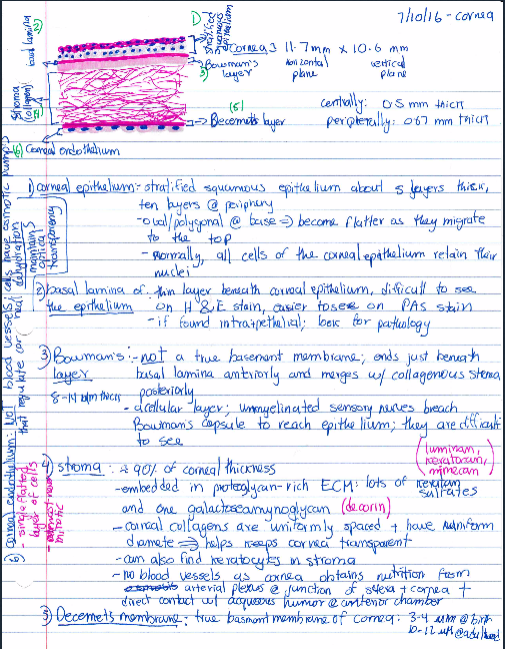
That being said, I will have to change how I study if I want to do it effectively. Now that I have a job besides passing the never-ending barrage of standardized tests the NBME throws at me, I can't take as much time studying as I used to. Up until now, I use hard copies or relevant print-outs of textbooks, then take notes and organize them as necessary. Perhaps it's because I didn't have access to computers until the second half of my childhood, unlike the rest of my peers, but I can't seem to absorb PDFs or ebooks. Typing my notes doesn't work either. For example, these are my notes for the normal histology of the cornea:
My art has not improved at all this year
I never gave it much thought before, but since I work from 7:30 AM to 5-8 PM, I wish I could work faster.
These promotional posters must be seen to be believed
This last couple of weeks, I've been watching Mr. Robot with my friend Chris. It's the first TV show I've re-watched from beginning to end in a long time. Probably the first one ever, actually. I can barely get myself to get through a whole season of TV once (still haven't finished the second season of Daredevil).
I've noticed several things about Mr. Robot the second time around, some of them big and some of them small. Darlene's early behavior doesn't seem so invasive in context, for example. Talking about the show with another person has also changed my mind about certain some of the show's themes. Most significantly, I'm not sure Mr. Robot's central premise about the loneliness of modern life, and the oppressive nature of its false choices, is as shallow and juvenile as I first thought.
Though I still think that Elliot is over the top with his multiple speeches about how the world sucks because everyone is always drowning in pop culture and posturing in social media, I've had time to consider that my reaction might not be so objective. I don't disagree with Elliot's conclusion that getting caught up with presenting a perfect, always-interesting face on social media generates anxiety, loneliness, and isolation, but I also believe that engaging in social media to that degree is a choice. So I couldn't fully sympathize with his anxiety because I felt like he was choosing to judge people sole through what they post on Facebook/Instagram/etc.
I was browsing through Netflix and noticed the following:
And I was like. . . Netflix is doing original anime?
It turns out that Netflix is just licensing and dubbing certain anime now. I like me some anime, so even though I'd never heard of this series, I decided to give it a shot. To this day, I've never looked up its history, so my knowledge is limited to the few dubbed episodes I watched before deciding it wasn't for me. I gathered that the story is set in generic anime fantasy Europe/Britain, where a squad of super powerful knights (that were also government officials?) called "The Seven Deadly Sins" plotted to take over the kingdom, and were then defeated by other super powerful "Holy Knights".
The story starts when a princess with a breathy voice (at least in the dub) stumbles into the main character's bar (the short blond guy on the banner above). Holy Knights are chasing her because they suspect that she's one of the Seven Deadly Sins, but it turns out that she's not. In fact, the short blond guy is actually Meliodas, The Dragon's Sin of Wrath and former captain of The Seven Deadly Sins. There's also this talking pig thing, a giant flying/travelling? turtle of some kind, and this weird Holy Knight who seems to have some backstory with both Meliodas and the princess with the breathy voice.
As I said earlier, I only watched a few episodes of this before calling it quits. The story line obviously didn't grab me as I have trouble recalling basic details, the female lead's voice grated on my nerves, and I was put off by the weird interactions between the female and male leads.
Eve Dallas married Irish prince charming last book, after defeating the evil villain with the magic anti-aging drug that kills users. This book starts when a young engineer with no history of depression or suicidality hangs himself in his room at Roarke's outer space resort, where Eve and Roarke are finishing their honeymoon. I think this might be the first time I read this installment because I remembered nothing of the plot. Except for one subplot I will get to in a minute, I quite enjoyed this book from beginning to end.
Since this series is set Twenty Minutes Into the Future but publication began in 1995, earlier installments have a decidedly retro-future feel to them. Most of the time, it's odd blips like state-of-the-art, futuristic computers running on "discs", or people remarking about how only certain professionals have "links" (cell phones) with them at all times. Other times, Robb includes moral dilemmas about "new" technologies and/or scientific advancements that hinge on outdated theories.
In this installment, Roberts tackles the controversy about "nature vs nurture" through the lens of "genetics vs. environment". I wouldn't say that this conflict has been settled already, but Rapture in Death was published in 1996 and the Human Genome Project was declared complete in 2003. The doctor that argues in favor of the genetics side of the debate in this book espouses ideas that would only be entertained in some weird neo-Nazi "scientific magazine" today. I'll let this quote speak for itself:
Not that Reeanna is an actual neo-Nazi, it's just that the scientific concensus today is that the relationship between genes and the environment is more complicated than "genes --> behavior"
I went to Connecticut this weekend to catch up with some of the more affluent members of my family. It was pretty fun. We went to a. . . semi-private? beach. It's hard to explain. I think only people who own houses and/or live in the area are accepted into the beach, so it was fairly clean. Best of all, it wasn't crowded at all. From what I understand, you can have barbecues in these types of little islets:
If you own a boat, of course.
Then we drove around the neighborhood to admire all the beach houses that my family members can't afford. (They own property about five minutes from the beach. I'd have asked how much it cost, but it would've been tacky. It's cool, though. One of my aunts asked and it was around 600k. Ten years ago).
Anyway, in all the talk about pretty things, my mother aunt started talking about a beautiful cousin I have who posts artsy pictures of herself on Facebook. I was only half-listening, but my ears perked up when one of my aunts lamented that my cousin looks way more beautiful in pictures than in real life. I didn't join in, but of course she does.
It's obvious that my cousin expends a lot of time on her pictures. I'm not knocking her. They're beautiful pictures. I wouldn't know how to make myself look like that even with filters and photoshop. But I wonder how she must feel like in person. Does she worry that her Facebook and Instagram posts set up a standard that she can never meet in real life? Does she enjoy posting those pictures even though she must know that people make snide comments about how they're "fake"?